
Another World, Rooted at Howard: Jamea Richmond-Edwards on Becoming a “Scholarly Artist”
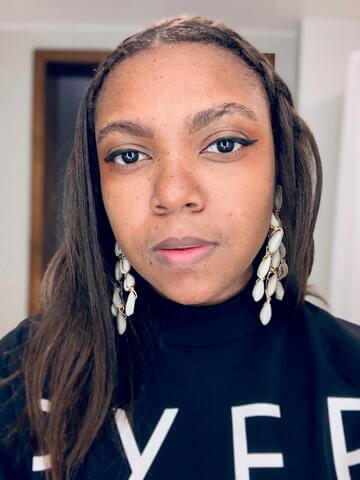
By Chad Eric Smith, Director of Strategic Communications and Marketing, Chadwick A. Boseman College of Fine Arts
As her acclaimed exhibition Another World and Yet the Same prepares to travel to the California African American Museum, the 2012 MFA graduate reflects on how Howard helped her transform hip-hop, family history, mythology, and research into an ever-expanding artistic language.
When Jamea Richmond-Edwards arrived at Howard University to begin her Master of Fine Arts degree in 2010, she was already an artist with a point of view.
She was also a mother of two, represented by Gallery Myrtis in Baltimore, and clear about why she had come to graduate school.
“I was standing on business,” Richmond-Edwards recalled. “It wasn’t no play play.”
What Howard offered was an opportunity to dig deeper—to give intellectual structure and scholarly rigor to ideas already taking shape in her imagination.
One of the earliest catalysts came from an unlikely graduate-seminar subject: hip-hop.
The year Richmond-Edwards entered Howard was also the year Kanye West released My Beautiful Dark Twisted Fantasy, an album whose ambitious visual world left a profound impression on her. She remembers asking a professor whether the class could examine the work seriously as art.
For Richmond-Edwards, it became part of a larger realization: the popular culture surrounding her could serve not merely as inspiration, but as material for rigorous artistic inquiry.
“That shifted my artistic trajectory,” she said. “Around 2010 is when I began really being able to articulate the real ideas that I wanted to unfold in my work.”
Fourteen years after earning her MFA from Howard in 2012, that impulse—to pull from seemingly disparate cultural, historical, personal, and scholarly sources—remains central to Richmond-Edwards’s practice.
It is an approach she connects naturally to hip-hop.
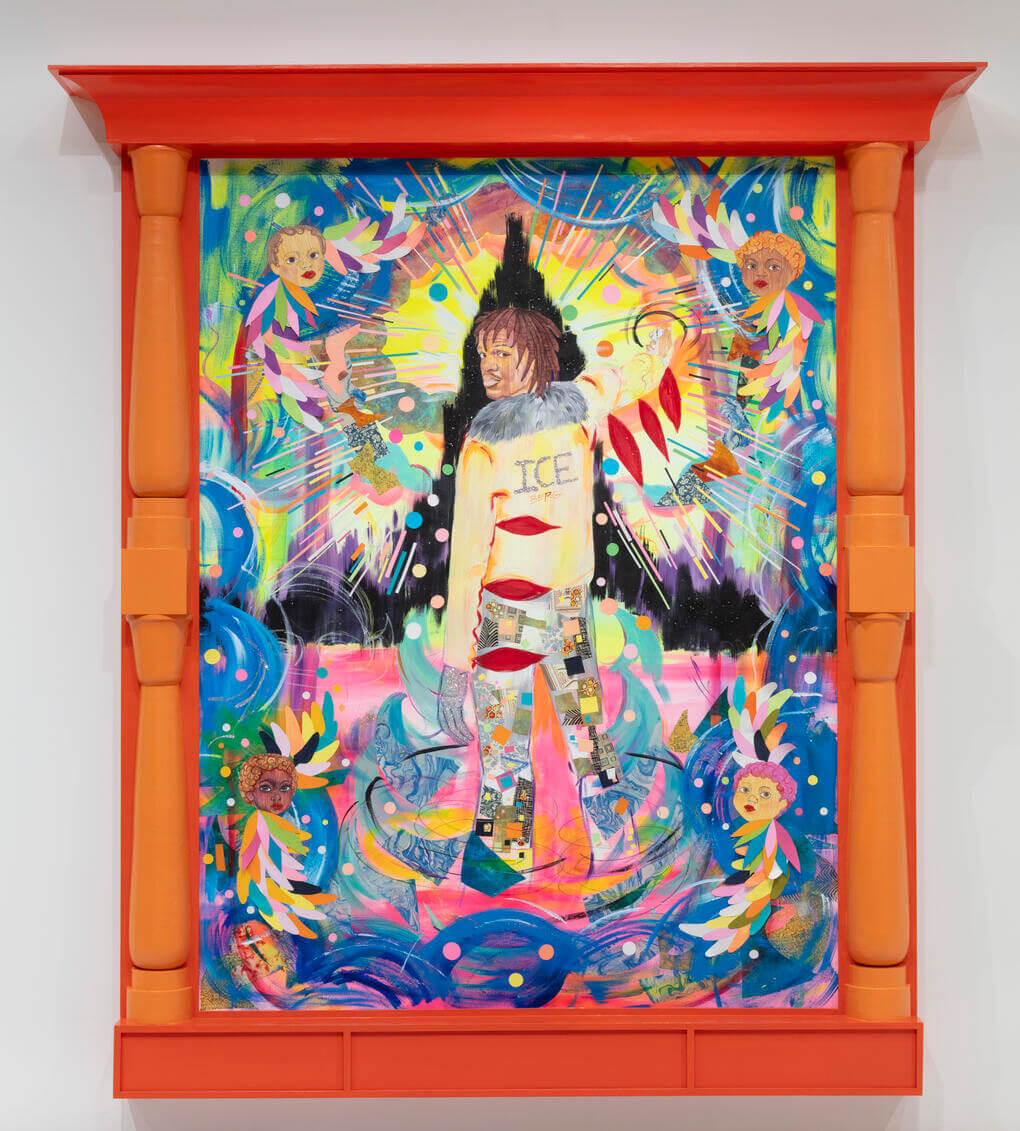
Like sampling, her work draws together elements that might initially appear unrelated: Detroit and mythology. Family history and speculative worlds. Hip-hop and jazz. Biblical narratives and geography. Fashion, architecture, memory, genealogy, and the imagined future.
The result is a visual language distinctly her own.
From Autobiography to Mythology
Following Howard, Richmond-Edwards exhibited extensively, first throughout the region and later nationally as her career expanded into New York and major museum spaces.
But while the reach of the work grew, its subject matter was evolving, too.
Earlier in her career, Richmond-Edwards looked closely at her own upbringing in Detroit and at experiences she felt were underexamined within contemporary art and scholarship—including the long cultural aftermath of the crack epidemic.
“I had something to say, and people listened to what I had to say,” she reflected.
Over time, however, the language she used to tell those stories began to change.
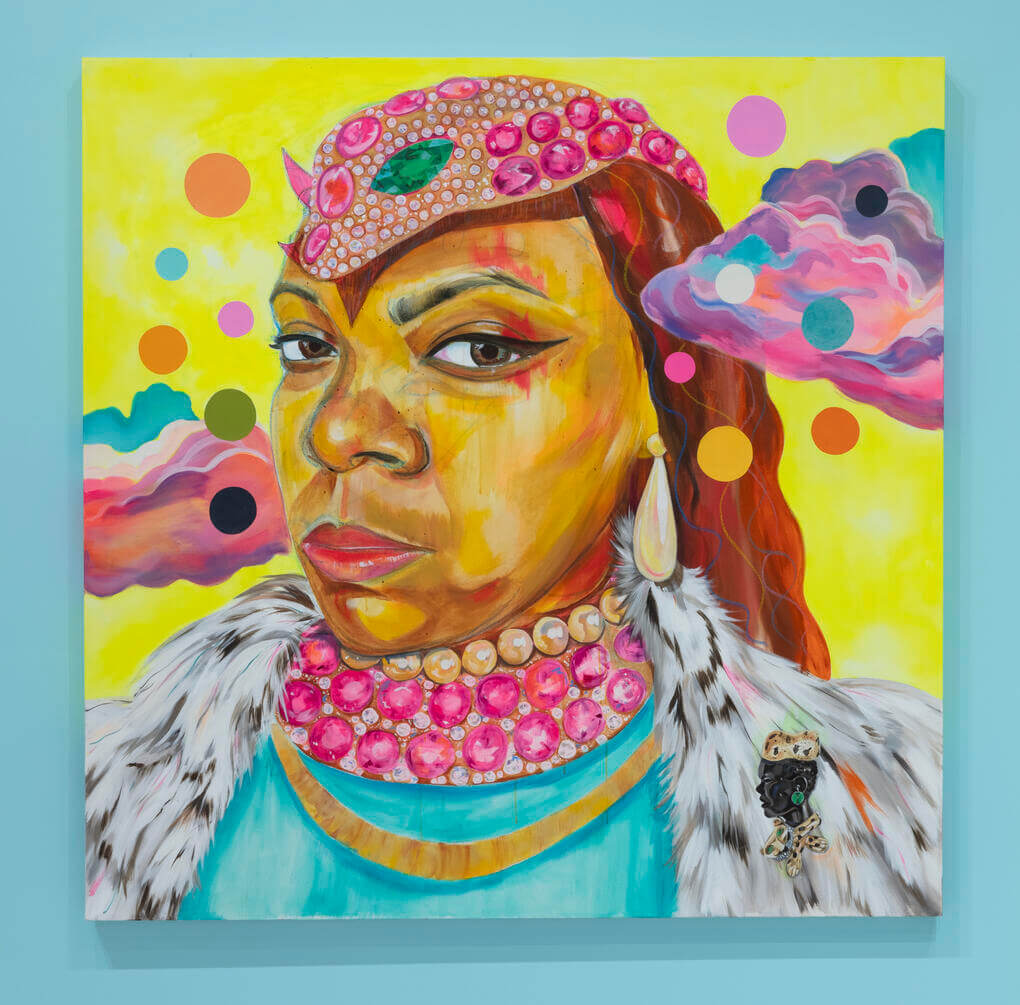
“You’ve seen the gradual transformation from very autobiographical to mythos, to mythology,” she said.
That transition did not mean leaving autobiography behind. Instead, Richmond-Edwards began finding increasingly expansive ways to express it.
Family stories became symbols. History became geography. Lived experience became metaphor.
I’m using metaphor to tell these stories, but it’s all real.
Genealogical research played a particularly important role in widening that lens. As Richmond-Edwards traced generations of her family history across different parts of the United States and beyond, she began thinking more deeply about land, migration, architecture, conflict, spirituality, and the complicated histories people carry across generations.
The research challenged her to see identity not as a fixed narrative, but as something layered across place and time.
Artistically, that opened possibilities.
It also sent her deeper into other forms of study—from mythology and spirituality to the music of Alice Coltrane and the histories embedded within geography itself.
The more she researched, the more expansive the work became.
Becoming a “Scholarly Artist”
For Richmond-Edwards, that union between research and creative practice remains one of the most important lessons of her Howard education.
That’s one thing Howard did teach me, is to be a scholarly artist.
It is a phrase that captures the methodology underlying much of her practice.
Richmond-Edwards does not approach research as material separate from the making of art. Scholarship provides part of the foundation from which the art emerges—allowing her to interrogate inherited narratives, construct new ones, and place personal experience in conversation with larger histories.
“Everything that I do,” she said, “I have a bibliography to complement it.”
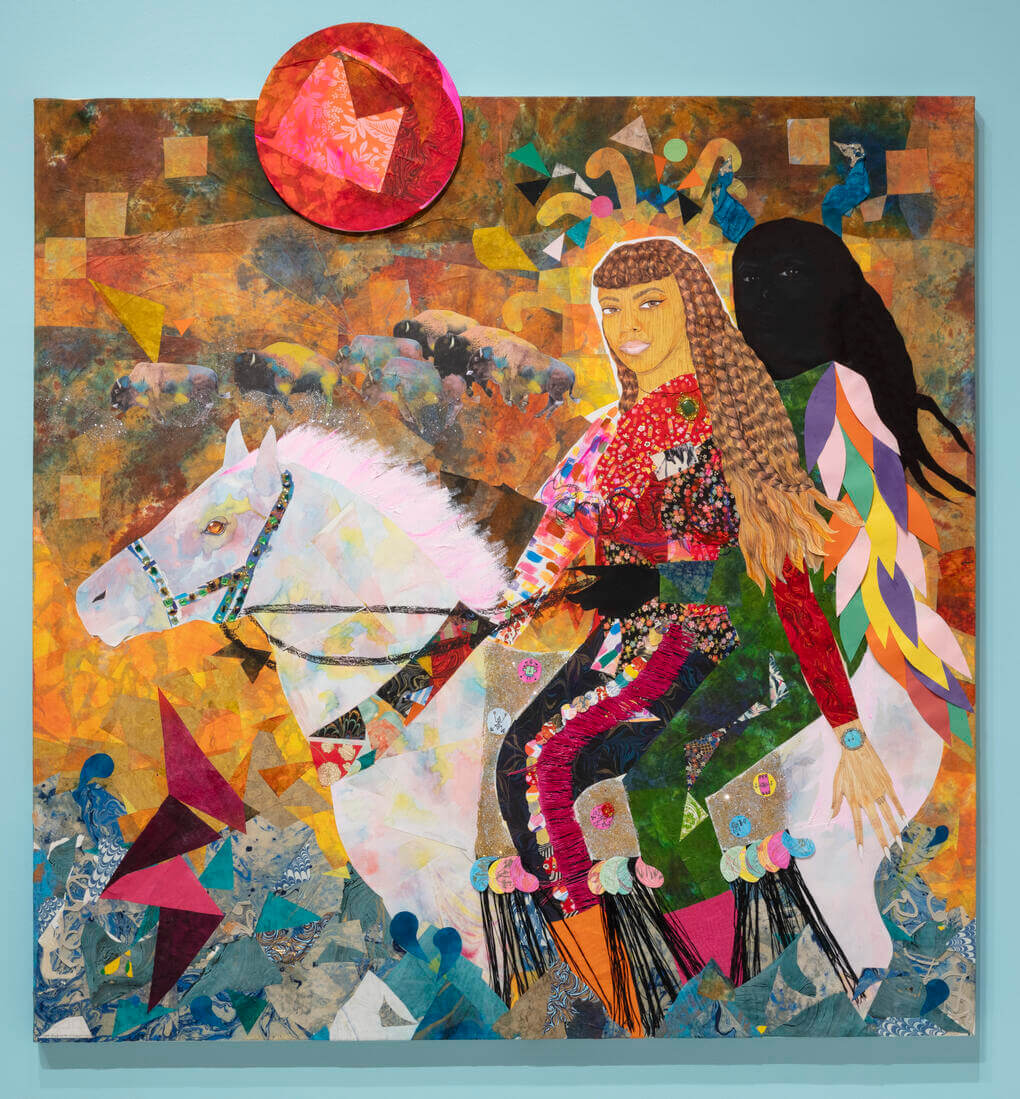
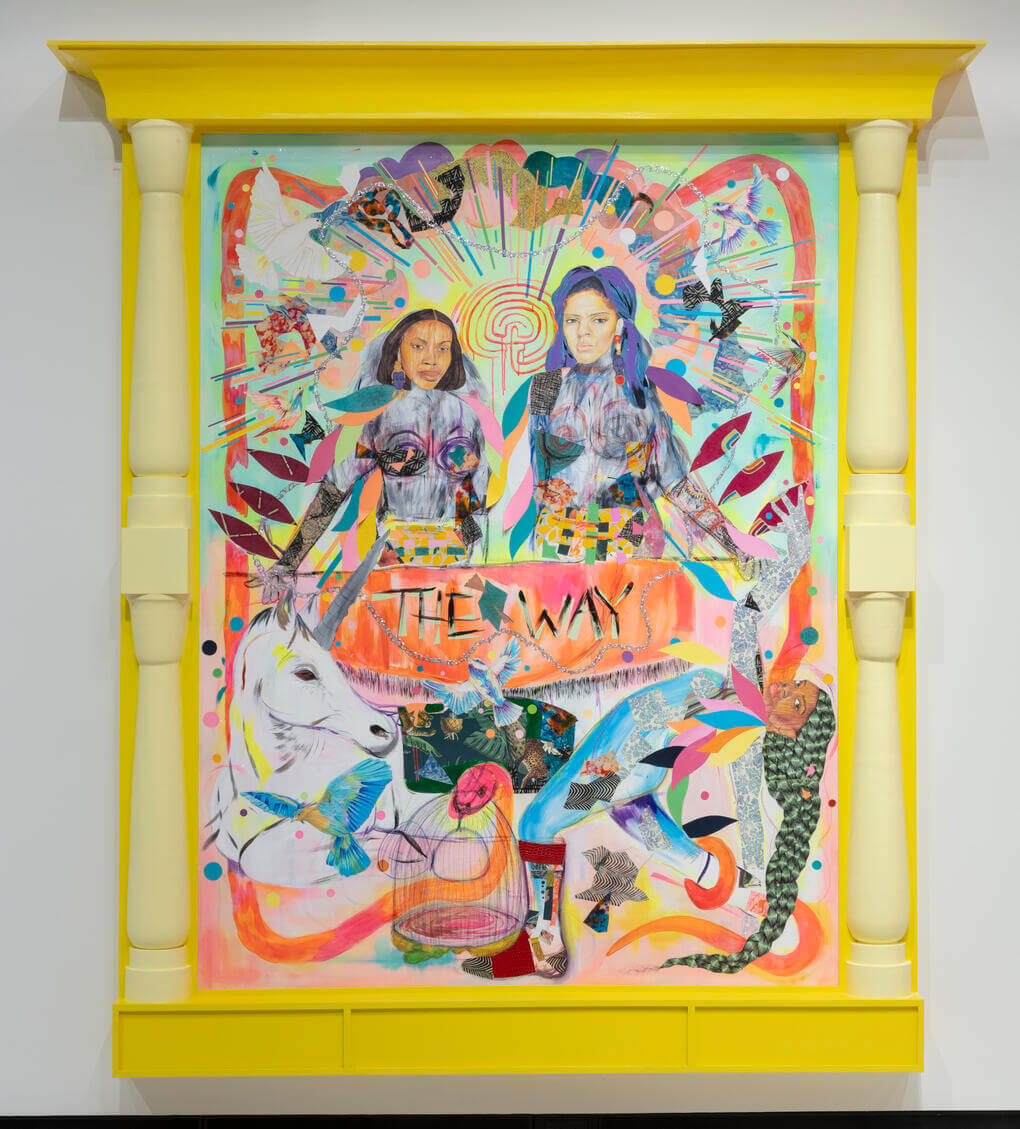
That intellectual rigor is now visible at monumental scale in Another World and Yet the Same, an interdisciplinary exhibition bringing together mixed-media paintings and newly created work rooted in the many currents that have shaped Richmond-Edwards’s artistic life.
Detroit remains present, as do music, fashion, family, and community. But those influences now coexist with Exodus narratives, mythology, imagined geographies, questions of migration and memory, and speculation about worlds beyond the one already known.
The exhibition’s title itself comes from Mundus alter et idem—translated as Another World and Yet the Same—a satirical early-17th-century imaginary voyage. Richmond-Edwards similarly uses imagined worlds to illuminate questions rooted firmly in this one.
The fantastical, in her work, is not an escape from reality.
It is another way of examining it.
Artistic Lineage, Community, and the People Who Shape Us
For all the expansiveness of Richmond-Edwards’s artistic universe, her practice remains deeply connected to the people, traditions, and cultural inheritances that have shaped her.
I’m a student of Alice Coltrane. I’m a student of jazz. I’m a student of my genealogy.
That sense of artistic lineage extends across disciplines and generations. Music, family history, visual art, spirituality, and scholarship all become sources from which Richmond-Edwards draws—part of a larger continuum rather than isolated influences.
Community also became visible in the presentation of Another World and Yet the Same at the Ruth and Elmer Wellin Museum of Art at Hamilton College, where Richmond-Edwards curated the companion exhibition EXODUS. The exhibition brought together seven artists whose mentorship, friendship, inspiration, and support helped shape her creative journey, including Howard-connected artists Akili Ron Anderson and Larry W. Cook.
That sense of artistic lineage also reaches back to Howard. Richmond-Edwards has spoken about the influence of Howard’s artistic traditions and the legacy of AfriCOBRA on the development of her visual language. The artists, educators, musicians, and histories she encountered became part of an ever-expanding ecosystem of ideas that continues to inform her practice.
Her work suggests that artistic development is rarely solitary. It is shaped by the people we learn from, the histories we inherit, the traditions we study, and the communities that make space for us to imagine beyond what we already know.
Another World, Another Audience
This fall, Another World and Yet the Same begins its next chapter.
After its run at the Wellin Museum in Clinton, New York, the exhibition will travel west to the California African American Museum in Los Angeles, where it is scheduled to open November 17, 2026.
Richmond-Edwards does not plan to fundamentally reframe the exhibition for its new home.
The work will remain the work.
What changes is the audience.
At Hamilton College, she watched students encounter the exhibition within an academic environment and bring their own thoughtful interpretations to what they saw. Now, as the exhibition moves to Los Angeles and into a different cultural and demographic landscape, she is curious about what another community will find in the same paintings, symbols, stories, and imagined worlds.
“The biggest difference is location and demographics,” Richmond-Edwards said. “Now it’s going to L.A., the heart of L.A. Now I’m interested to see, how is it going to resonate with the people, with the culture?”
The paintings do not change.
The language does not change.
But the lens through which they are understood inevitably does.
The same work can carry one meaning in Clinton, New York, and another in Los Angeles. A viewer brings geography, history, culture, memory, and identity into the gallery alongside them.
In that sense, the exhibition’s journey west reflects something already embedded within Richmond-Edwards’s practice: the possibility that multiple histories and meanings can occupy the same space at once.
Past, present, and future.
Autobiography and mythology.
The deeply personal and the expansively imagined.
Another world—and yet the same.